miércoles, 4 de marzo de 2009

A Call for Questions

Dear Readers,

I want to interview Venezuelans using your questions related to Venezuela´s culture, economy and political climate. Please email me questions or write them in the comments section of this entry. These are some of the questions that I have received so far:
  1. "How does the typical Venezuelan maintain close family relationships and raise adults with good values? Are they largely Church based in their approach to life or non-faith based?" -Marcia
  2. "How well informed and concerned is the average Venezuelan about environmental issues such as global warming, loss of habitat for animals and plants, over population, ecological degradation, genetic manipulation of our food supply, etc. etc?"-Marcia
  3. "Why this anti-semitic eruption. Are the people against the Jews-Israel or is this a political ploy of the government. What is the history of anti-semitismin V?" -Terry
  4. "Overall, do you feel that the USA has been a force for good or a force for oppression within central and South America ?" -Richard

Please keep the questions coming! I would love my interviews to be as dynamic as possible. Thanks.

Un abrazo,

Jeremy

PS: Keep reading below in case you have not read my recent entry about Carnaval.

domingo, 1 de marzo de 2009

Dionysus Meets Calypso

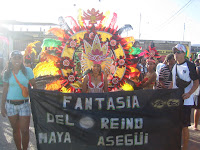
The calypso-throbbing car ride was a prelude to the imminent madness as I traveled from Cumaná to Güiria – the hometown of my friend Chichi. In this large town, I planned to celebrate my first Carnaval. Not far from the island of Trinidad, Güiria lies to the east of Cumaná and boasts a prominent Afro-Caribbean culture. Every year, Güiria’s celebration includes three days of parades through its streets, and groups compete with themed floats and costumes to win cash prizes. This year, Chichi’s family chose the theme Reino Maya (“Mayan Kingdom”). Upon their invitation, I decided to partake in the family’s efforts and merrymaking and was ready to help with the preparations upon arrival in Güiria. I was in the car with Chichi’s cousin, Kathi, for Chichi had gone to his town a few days earlier to prepare for the festivities. As the music thumped from the car’s oversized speakers, Kathi warned me: “Carnaval will be pure calypso.”

I arrived at Chichi’s house to witness a mess of cardboard, foam, glue, colored paper, sequins, and glitter, representing the whole gamut of arts and crafts supplies. It was Friday evening, and precious little time remained. We had less than forty-eight hours to re-construct the Mayan kingdom. Sunday was to mark the beginning of the parades, serving as a short, introductory stroll around the town. The parades were to become progressively longer and more elaborate on Monday and Tuesday. As I arrived, most of the people at Chichi’s house had finished their costume making for the day, so the evening strictly involved introductions as I met family members and friends.

The next day’s work party was light-hearted yet focused. After early morning coffee, Saturday went by as a frenzy of supply shopping and costume making. We took unusually short breaks to eat between long intervals of work. Surprisingly, this operation was well managed and determined in order to maximize productivity; Venezuelans do not mess around when it comes to their celebrations. After calling it quits for the day, we had a quick dinner and then went to the central plaza to dance to Trinidadian calypso bands until 3:30 in the morning. Everyone considered this a well rounded day for the Carnaval season.
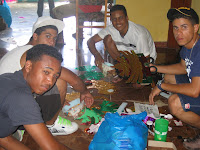
On Sunday morning, we continued to prepare for the first parade.
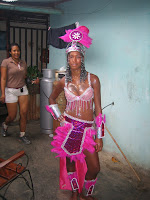
The majority of the twenty-five young women in our group had their costumes ready and began dusting their bodies with glitter by 3:00, yet most of the men had not finished their costumes. Those who were ready joined the parade as part of the gradual warm-up to welcome Carnaval. In this spirit, I attempted to get some pointers on calypso from the dancers in the group, braving many chuckles and befuddled stares. Nonetheless, the tutorial felt beneficial; I slowly felt more comfortable gyrating to the music.

After the introductory procession finished, late night dancing in the plaza followed again until 2:30 am.

The dozen or so men finished their costumes by the Monday afternoon, ready to complement the female dancers. We arrived at the starting-point of the parade on time around 4:00, and the parade began a short while after Chichi and his parents directed us into our formation. Lubricated with Venezuelan-made Cacique rum, our mini-Mayan kingdom shimmied, trotted, gyrated and boogied through the whole town, following a truck decked out with six large speakers that blasted the same three Calypso songs over and over again. Despite the constant dancing, the body pays no attention to fatigue under these conditions. The revelry ended five hours later, and my exhaustion hit me hard. We came home to change out of our costumes, and, though Chichi and his friends went back to the plaza to continue, I plopped my pseudo, Mayan-clad body onto my bed. I became a corpse that was not about to move anytime soon.

That evening’s solid nine hours of sleep helped me recover, and we all needed sufficient energy for the final parade. The festival’s judges were to evaluate the different groups, so this day counted the most as far as the competition was concerned. Yet so much work remained because we had not finished our group’s most elaborate costumes. Moreover, the glitter, sequins, and shiny paper had begun to fall off my costume’s cardboard skeleton, requiring ample treatment with the hot glue gun. The fervent day progressed from governable madness to frenetic insanity as dozens of people ran around the house shouting for help, fishing for stray supplies, and dousing costumes with the final reserves of glitter. Yet by mid-afternoon, the fiasco had barely begun.

The following is an abridged chronology of the final day’s nine-hour debacle:
3:00 – Parade groups must arrive at parade origin; Reino Mayan is still at its headquarters (a.k.a. Chichi’s house).
3:30 – Half of the Reino Maya is ready while the other half completes “finishing touches.”
4:30 – Individuals of the Reino Maya who are ready – approximately 70% of the group – depart and find a spot in the parade near the center of town.
4:45 – Chichi´s parents decide that we must wait for the rest of the group, so we leave the parade.
5:30 – The rest of the group arrives, including our group’s drag queen (see adjacent photograph), and we find a new spot in the parade.
6:30 – The Reino Maya passes by the judges, eking out smiles despite our collective exhaustion. Loop number one around the town is completed near the plaza.
7:30 – Our group gets mid-way through loop number two. Despite the continual calypso music, my hips cease to gyrate.
8:30 – Completing loop number two, we arrive at the plaza, and I am near the point of physical collapse.
8:45 – The judges announce the top five groups. The Reino Maya goes unmentioned.
9:15 – Defeated, we disrobe our regalia and kvetch. My feet are numb.
10:00 – Chichi and his friends decide that they want to continue the rumba (“party”), which brings us back to the hoards of calypso dancers in the plaza.
12:00 – Carnaval officially ends, prompting the calypso music to stop. Finally.
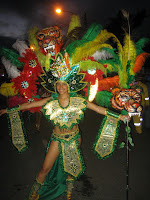


Having experienced four and a half days of preparation and celebration, and I can now comprehend a few of Carnival’s major attributes with greater clarity. Attribute number 1: the inescapability of glitter. We used glitter abundantly to decorate our costumes because dullness has no place in Carnaval. Yet the omnipresence of glitter was absurd. Despite bathing twice a day since arriving at Chichi’s house, glitter adhered to my hair and skin. I found it in my bed. I found it on the bathroom floor. All of my clothes were speckled with glitter. Attribute number 2: the mesmerizing and sensual singularity of calypso. Calypso music and the accompanying dance support the Venezuelan saying, “Carnaval is carnal.” See the video clip below to better understand this phenomenon (click here). Attribute number 3: progressive exhaustion. Besides a lack of sleep, my body experienced soreness from the pelvis down: hips, thighs, hamstring and feet. Upon moving my body in ways I had never attempted, I utilized new muscles that began to ache. Most of this fatigue undoubtedly resulted from the three, four or five hour periods of straight dancing during the afternoon parade and the nighttime concerts in the plaza. It appeared as though the town of Güiria tried to kill me with so much dancing, and I thought to myself by the end, “At least I’ll be lightly dusted in glitter if I die.” Yet out of all parties that I have ever attended, this was the most fun, absorbing, and Dionysian of them all. It would be a shame to never spend another Carnaval in Güiria ever again.

domingo, 8 de febrero de 2009

From the Sidelines

“So what do you think of Chávez?” I cease to count the number of Venezuelans who ask me this question, one that provokes most Venezuelans to either venerate or curse their controversial president. Neither sheepish nor self-censored in his conduct, Hugo Chávez and his United Socialist Party of Venezuela (PSUV) run a political machine that has decimated the power of the fractured opposition, allowing Chávez to garner power. His efforts continue as he calls the country to vote on a constitutional amendment that, if passed, would end presidential term limits. Political views are extremely polarized in this country, manifested by an omnipresent politicized culture that is electrified and sometimes volatile. This culture, which I see every day in one form or another, gets closer and closer to the breaking point in light of the upcoming vote.

Campaigners set up posts throughout every neighborhood of Cumaná. At these sites, groups of red-clad PSUV party members promote the president’s constitutional amendment in preparation for the vote on February 15th. The amendment would allow President Chávez – as well as governors, mayors and senators – to run for the same elected office without term limits. The current two term limit requires Chávez to end his presidency in 2012, though this amendment would allow him to run for a third presidential term. His campaign’s force upon the senses cannot be overstated. The masses of his supporters wear red shirts that state: “Chávez Sí,” “¡Uh! ¡Ah! Chávez con el Pueblo Sí Va,” to name a few. One also encounters shirts bearing the images of Chávez, Che Guevara, and the ubiquitous star of the PSUV. And behind every large group of supporters lies a pickup truck with large speakers. At full volumen, campaigners play salsa, joropo and samba music commissioned by the president. This bizarrely political tropical music extols the virtues of “el comandante Chávez” and socialism, arguing that the president must stay.

Of course, no political campaign would be complete without sufficient literature, and one can find plenty. For example, a member of the local port workers´ union handed me a pamphlet to promote the amendment. It posits that the amendment would “strengthen and consolidate the internal unity of the Bolivarian forces for the leader of the Revolution, being a forceful message against the enemies of the patria inside and outside of Venezuela." In the case that the amendment were to fail, the pamphlet continues, “Varied forms of political retaliation and vengeance against the people would be committed by the oligarchs. Their truly fascist essences remain withdrawn as they wait their moment,” The rhetorical tone of chavista (pro-Chávez) supporters is noteworthy; they take advantage of the polarized political scenario and impart a pressing sense of urgency.

While the campaigners don their red shirts, disperse their pamphlets and play music encoded with subliminal socialistic messages, a less coordinated and more subtle manifestation of discontent pops up in many places.

At the university’s Department of Modern Languages, most English professors with whom I work readily denounce Chávez, blaming nearly all of Venezuela´s domestic problems (e.g., rising delinquency, inflation, unemployment, etc.) on their president. For example, one co-worker sends her friends text messages that joke about the president. Others lament that it is difficult to find a job unless one has PSUV membership. Suffice it to say, red is a color rarely found within the offices of the Department of Modern Languages.

While waiting for the bus last Tuesday, I overheard an elderly man as he harangued his wife about the government: “Este país está arrecho,” essentially meaning fouled up beyond all recognition. He continued to argue that the country cannot function with so many days off, referring to the previous Monday and Tuesday that Chávez declared a national holiday. The president intended to commemorate the ten-year anniversary of his “revolutionary” government but declared the holiday less than forty-eight hours before on Saturday evening. The gentleman added that Venezuela will probably shut down for a whole week if Chavéz wins his constitutional amendment.

However, those who oppose the current government fail to muster any cohesive voice against the petroleum-dollar spending political machine of Chávez. In downtown Cumaná, the only opposition slogan found painted on the walls is “No is No.” I noticed this painted on a few walls compared to the thousands of murals and posters that promote the amendment.

The abundant posters, chants, songs, reproachful comments, graffiti and t-shirts make me dizzy at times. I felt this effect last Tuesday having heard the man at the bus stop and then passing by hoards of chavistas on the street during the bus ride. After hoping off the bus in the historic downtown, I strolled past the remains of the old capital building (see picture above), once the office of the Sucre State governor. A group of students firebombed the building years ago during protests. Ironically, the remaining façade and the vegetation within the ruins present a numbing yet eloquent image; it is a stark local symbol of political clashes at their worst. I recalled the question: “So what do you think of Chávez?” “Neutral,” I tell myself. It is best to stand on the sidelines when confronted by Venezuelan politics.

jueves, 15 de enero de 2009

Impact of Falling Oil Prices in Venezuela

Check out this New York Times article. It addresses the impact of falling oil prices on the political and social agenda of the Hugo Chávez government (Read it!).

domingo, 11 de enero de 2009

Venezuela on a Plate

I say gracias a Dios every time that Richard, my Venezuelan housemate, invites me to try the food that he prepares. Reticent yet good humored, Richard studies math at the university where I work in Cumaná, but he was born and raised in a small rural town a three hours away called Río Caribe. The best word to describe him in Yiddish would be a male baleboosteh: an excellent and praiseworthy homemaker.* Though Richard has yet to make cholent or kasha and varnishkes,** his culinary interpretations of traditional Venezuelan fare are never less than superb. Richard told me a few weeks ago that he would teach me to make arroz con pollo (chicken and rice) under the condition that I buy the chicken. Who would ever kvetch‡ at the proposition of a cooking class that were to cost only a chicken? Giving up a golden opportunity such as this would be a real shandeh†; I accepted.

Common logic, for better or worse, dictated that we would have to go to a market in order to buy a chicken. Accordingly, off we went to the Express Mall supermarket the previous evening. Before we checked out at the cash register, I decided to go on an extended tour of the supermarket in order to browse and ascertain the scarce food items of the week. There is never an extreme shortage of food at the supermarket, yet there are always a few food items in scarcity. I do not yet fully understand the specific economic mechanisms that influence this occurrence – further investigation is required. For example, a few basic items like sugar fail to appear on store shelves for weeks at a time; stocks of some luxuries like ice cream are often nearly depleted; and, most paradoxically, ground coffee recently disappeared from supermarkets after its price doubled, which is most surprising given the flourishing presence of local coffee production within hours of Cumaná. Regardless, most items in stores are regularly available, including the necessary staples to make arroz con pollo. Richard and I came home that evening with every ingredient.

Richard and I began to cook around noon the next day. As we went through the different steps, I jotted down the recipe, which can be found at the end of this entry. No major mishaps occurred fortunately. The pot of chicken and rice did not explode nor fall down on the ground. Neither of us burned anything.

Our two friends Mery and Albelk stopped by to join our feast, and we began to eat shortly after Albelk prepared fresh squeezed orange and parchita fruit juice. We served the arroz con pollo onto each individual plate, completing each with a garnish of fried plantain. The table was set. Appreciative of the rich plates of food in front of us, we duly exchanged the Spanish phrase buen provecho, meaning “bon appetite,” and the lull in the conversation thereafter indicated the success of the food. I noticed that I was consuming my meal slower than my friends while I struggled to separate the chicken from the bone. Mery soon caught onto my difficulties and stated directly that Venezuelans eat chicken with their hands. Constructive criticism during a meal never hurts when it eases the eating process and harmonizes the etiquette of all at the table. Nervous yet determined, I picked up the chicken with my bare hands and truly joined in on the feast. Not a single morsel was left on my plate soon after.

Click to see the rest of my photos from the cooking lesson.


Recipe: Richard´s Arroz con Pollo
Ingredients:

3 cups of rice
4.5 cups of water
1 chicken breast or 5 thighs
Adobo spice (powder mix)
10 cloves of garlic, mashed
Rum, preferably Venezuelan (optional)
Hot sauce
3 medium-sized tomatoes
1 large onion
1/2 green pepper
Vegetable oil
Salt
One large ripe plantain

1. Remove the skin and fat from the chicken with a sturdy knife, breaking it into small chunks. Leave the meat on the bones, and place into a large pot.
2. Sprinkle the adobo spice liberally onto all the pieces of chicken.
3. Place mashed garlic into the pot along with a few splashes of hot sauce. Add a few splashes of rum.
4. Dice the tomatoes, onion, and pepper into very small chunks. In a frying pan, heat the vegetable oil and sauté the vegetables until well cooked and slightly browned. This is called aliño.
5. Place the pot of chicken pieces onto the stove, turn onto high heat, and add the aliño to the chicken. Cover the pot and cook 15-20 minutes or until the chicken is cooked.
6. Add the rice and water to the pot of chicken. Add salt to the water to taste. Bring water to boil, cover pot, and reduce stove to low heat. Cook for 20 minutes.
7. As the rice cooks, prepare the fried plantains separately. Slice plantains into 1/4-inch thick slabs. In a pan, fry the plantains in hot vegetable oil until tender and medium browned. Remove from the pan and allow to cool.
8. Serve the rice and chicken in a large plate. Garnish with fried plantains on top.

*Note: according to Leo Rosten´s The Joys of Yiddish, the male equivalent of baleboosteh would be baleboss, meaning “the head of the household; the man of the house.” Yet in practice, the latter of the two fails to encapsulate the ability to cook phenomenally, so I choose baleboosteh at the risk of violating the Yiddish gender dichotomy
** Two delicacies that every ashkenazic Jewish grandmother should know how to prepare (Yiddish)
‡ Complain (Yiddish)
† Shame (Yiddish)

viernes, 26 de diciembre de 2008

Two Beaches Side by Side

My plane arrived in Santiago from Caracas at about 11:00 pm. Finally, I had returned to Chile since my studies in Concepcion and Santiago three years ago. My year studying abroad in Chile had a big impact on me, yet many other experiences had occurred since then: graduation from college, a few short jobs and internships, a seven month period living in Mexico, among others. Most recently, I have adjusted to the culture and, to a lesser extent, the tropical climate of Venezuela. Though they are both South American countries, the difference between Venezuela and Chile is like night and day. And though Chile always occupied a special place in my heart, I felt nervous before my arrival as many questions simmered in my head: Were my memories and love for Chile embellished and dated? Would Chile sweep me off my feet the way that it did once upon a time? How do Chile and Venezuela compare with one another side by side?

To answer these questions, I have to take you to two beaches: Mochima in Venezuela, and Llico in Chile. The first might be confused for a steamy version of paradise upon first glance. If you look at your feet, which are probably bare, you see fine white granules of sand, free of garbage, seaweed, and other types of detritus. Looking down further, a soft breeze tosses the crystalline water into gentle waves; a handful of ostentatious yachts rest not far from the hot sand. Mochima is a protected national park near my current residence in Cumaná, Venezuela. On occasions such as this, life feels good, and I cannot kvetch. I am lucky to have the company of my Venezuelan friends Eliana, Roamir, Pablo, and Rachel, another North American English teacher. Of course, we are not alone: other beach-going Venezuelans pack the shore too. Given the hot weather, everyone tends to minimize the amount of clothing worn. For better or worse, the women with bikinis have their speedo-sporting male counterparts as well. "To each his own," I think. The beach in Venezuela typically is no place for modesty.

One can observe this effusive air by the anthropogenic sounds too. In addition to the soft breeze, the Latin beats of salsa, merengue, and reggaeton are as loud and inescapable at the beach as they are in the streets of downtown Cumaná. Moreover, my friends (mainly the male ones) constantly joke in a raucous manner without a concern for the volume of their voices. And why should anyone worry? There is no reason to hush one’s voice when children and adults alike scream as they play in the warm Caribbean water.


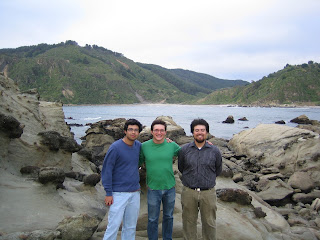
The second beach has a very different feel as I look down at my feet, closed toed shoes still on, and see that the sand is darker and less fine. Though it is on the same continent of South America as Mochima, one sees, feels and hears stark differences in the fishermen’s cove of Llico in southern Chile where I stand with my two good friends Lucho and Cristian Díaz*. Upon looking at the expanse of beach, I see a mosaic composed of seaweed, broken shells, black speckled sand and wind-swept bluffs. Wind is the operative word in this land because it is strong and inescapable, complemented by the crash of the waves. The large trees brave the wind’s force, yet there is certainly no Caribbean palm tree in sight, nor do the locals slurp down piña coladas to wash down their empanadas. Regardless, plenty of Chilean families enjoy the beach’s rugged beauty, though it is not as packed as its aforementioned Venezuelan counterpart. Locals test their nerves in the frigid water of the Pacific Ocean, yet taking a dip is less tempting for me, especially as I think about the tropical waters of Mochima. I am more than content admiring the scenery.

And certain acoustic qualities of the beach in Llico are apparent in every corner of the country. True to its Latin American identity, the streets in the Chile have the ongoing serenade of reggaeton and other Latin American pop music. However, the music is rarely heard at ear-drum bursting volumes that assault all who trot the streets of Venezuela. I have also noticed that people tend to speak at a slightly hushed volume in Chile, and the jokes told by Chileans come off as more tame and lack the double meaning that is characteristic of the Venezuelan sense of humor. Regardless, I have a wonderful time with Lucho and Cristian, who –like my Venezuelan friends Eliana, Roamir and Pablo – provide great company, local knowledge and their own well-rounded sense of humor. Based on such observations, Chile begins to feel as sincere as much as it is conservative, measured, and subtle in its style.

The juxtaposition of this tamed temperament and the coastal landscape creates a timeless allure in this country. In other words, one encounters warm and inviting people who are willing to share everything in the face of impressive yet less-than-paradisal landscapes. Neither better nor worse than the offerings of Venezuela, it is simply different. Llico absorbs me completely before long, tempting me to stare along the whole coastline as the wind jostles my hair. I cannot get enough of it.


*Lucho and Cristian are both from the fishing town Lebu, which is about an hour and a half from Llico. The pictures from Chile in this post were taken in Lebu.