jueves, 15 de enero de 2009
Impact of Falling Oil Prices in Venezuela
Check out this New York Times article. It addresses the impact of falling oil prices on the political and social agenda of the Hugo Chávez government (Read it!).


domingo, 11 de enero de 2009
Venezuela on a Plate
 I say gracias a Dios every time that Richard, my Venezuelan housemate, invites me to try the food that he prepares. Reticent yet good humored, Richard studies math at the university where I work in Cumaná, but he was born and raised in a small rural town a three hours away called Río Caribe. The best word to describe him in Yiddish would be a male baleboosteh: an excellent and praiseworthy homemaker.* Though Richard has yet to make cholent or kasha and varnishkes,** his culinary interpretations of traditional Venezuelan fare are never less than superb. Richard told me a few weeks ago that he would teach me to make arroz con pollo (chicken and rice) under the condition that I buy the chicken. Who would ever kvetch‡ at the proposition of a cooking class that were to cost only a chicken? Giving up a golden opportunity such as this would be a real shandeh†; I accepted.
 Common logic, for better or worse, dictated that we would have to go to a market in order to buy a chicken. Accordingly, off we went to the Express Mall supermarket the previous evening. Before we checked out at the cash register, I decided to go on an extended tour of the supermarket in order to browse and ascertain the scarce food items of the week. There is never an extreme shortage
  of food at the supermarket, yet there are always a few food items in scarcity. I do not yet fully understand the specific economic mechanisms that influence this occurrence – further investigation is required. For example, a few basic items like sugar fail to appear on store shelves for weeks at a time; stocks of some luxuries like ice cream are often nearly depleted; and, most paradoxically, ground coffee recently disappeared from supermarkets after its price doubled, which is most surprising given the flourishing presence of local coffee production within hours of Cumaná. Regardless, most items in stores are regularly available, including the necessary staples to make arroz con pollo. Richard and I came home that evening with every ingredient.
Richard and I began to cook around noon the next day. As we went through the different steps, I jotted down the recipe, which can be found at the end of this entry. No major mishaps occurred fortunately. The pot of chicken and rice did not explode nor fall down on the ground. Neither of us burned anything.
 Our two friends Mery and Albelk stopped by to join our feast, and we began to eat shortly after Albelk prepared fresh squeezed orange and parchita fruit juice. We served the arroz con pollo onto each individual plate, completing each with a garnish of fried plantain. The table was set. Appreciative of the rich plates of food in front of us, we duly exchanged the Spanish phrase buen provecho, meaning “bon appetite,” and the lull in the conversation thereafter indicated the success of the food. I noticed that I was consuming my meal slower than my friends while I struggled to separate the chicken from the bone. Mery soon caught onto my difficulties and stated directly that Venezuelans eat chicken with their hands. Constructive criticism during a meal never hurts when it eases the eating process and harmonizes the etiquette of all at the table. Nervous yet determined, I picked up the chicken with my bare hands and truly joined in on the feast. Not a single morsel was left on my plate soon after.
Click to see the rest of my photos from the cooking lesson.
Recipe: Richard´s Arroz con Pollo

Ingredients:
3 cups of rice
4.5 cups of water
1 chicken breast or 5 thighs
Adobo spice (powder mix)
10 cloves of garlic, mashed
Rum, preferably Venezuelan (optional)
Hot sauce
3 medium-sized tomatoes
1 large onion
1/2 green pepper
Vegetable oil
Salt
One large ripe plantain
1. Remove the skin and fat from the chicken with a sturdy knife, breaking it into small chunks. Leave the meat on the bones, and place into a large pot.
2. Sprinkle the adobo spice liberally onto all the pieces of chicken.
3. Place mashed garlic into the pot along with a few splashes of hot sauce. Add a few splashes of rum.
4. Dice the tomatoes, onion, and pepper into very small chunks. In a frying pan, heat the vegetable oil and sauté the vegetables until well cooked and slightly browned. This is called aliño.
5. Place the pot of chicken pieces onto the stove, turn onto high heat, and add the aliño to the chicken. Cover the pot and cook 15-20 minutes or until the chicken is cooked.
6. Add the rice and water to the pot of chicken. Add salt to the water to taste. Bring water to boil, cover pot, and reduce stove to low heat. Cook for 20 minutes.
7. As the rice cooks, prepare the fried plantains separately. Slice plantains into 1/4-inch thick slabs. In a pan, fry the plantains in hot vegetable oil until tender and medium browned. Remove from the pan and allow to cool.
8. Serve the rice and chicken in a large plate. Garnish with fried plantains on top.
4.5 cups of water
1 chicken breast or 5 thighs
Adobo spice (powder mix)
10 cloves of garlic, mashed
Rum, preferably Venezuelan (optional)
Hot sauce
3 medium-sized tomatoes
1 large onion
1/2 green pepper
Vegetable oil
Salt
One large ripe plantain
1. Remove the skin and fat from the chicken with a sturdy knife, breaking it into small chunks. Leave the meat on the bones, and place into a large pot.
2. Sprinkle the adobo spice liberally onto all the pieces of chicken.
3. Place mashed garlic into the pot along with a few splashes of hot sauce. Add a few splashes of rum.
4. Dice the tomatoes, onion, and pepper into very small chunks. In a frying pan, heat the vegetable oil and sauté the vegetables until well cooked and slightly browned. This is called aliño.
5. Place the pot of chicken pieces onto the stove, turn onto high heat, and add the aliño to the chicken. Cover the pot and cook 15-20 minutes or until the chicken is cooked.
6. Add the rice and water to the pot of chicken. Add salt to the water to taste. Bring water to boil, cover pot, and reduce stove to low heat. Cook for 20 minutes.
7. As the rice cooks, prepare the fried plantains separately. Slice plantains into 1/4-inch thick slabs. In a pan, fry the plantains in hot vegetable oil until tender and medium browned. Remove from the pan and allow to cool.
8. Serve the rice and chicken in a large plate. Garnish with fried plantains on top.
*Note: according to Leo Rosten´s The Joys of Yiddish, the male equivalent of baleboosteh would be baleboss, meaning “the head of the household; the man of the house.” Yet in practice, the latter of the two fails to encapsulate the ability to cook phenomenally, so I choose baleboosteh at the risk of violating the Yiddish gender dichotomy
** Two delicacies that every ashkenazic Jewish grandmother should know how to prepare (Yiddish)
‡ Complain (Yiddish)
† Shame (Yiddish)
** Two delicacies that every ashkenazic Jewish grandmother should know how to prepare (Yiddish)
‡ Complain (Yiddish)
† Shame (Yiddish)
viernes, 26 de diciembre de 2008
Two Beaches Side by Side
My plane arrived in Santiago from Caracas at about 11:00 pm. Finally, I had returned to Chile since my studies in Concepcion and Santiago three years ago. My year studying abroad in Chile had a big impact on me, yet many other experiences had occurred since then: graduation from college, a few short jobs and internships, a seven month period living in Mexico, among others. Most recently, I have adjusted to the culture and, to a lesser extent, the tropical climate of Venezuela. Though they are both South American countries, the difference between Venezuela and Chile is like night and day. And though Chile always occupied a special place in my heart, I felt nervous before my arrival as many questions simmered in my head: Were my memories and love for Chile embellished and dated? Would Chile sweep me off my feet the way that it did once upon a time? How do Chile and Venezuela compare with one another side by side?
 To answer these questions, I have to take you to two beaches: Mochima in Venezuela, and Llico in Chile. The first might be confused for a steamy version of paradise upon first glance. If you look at your feet, which are probably bare, you see fine white granules of sand, free of garbage, seaweed, and other types of detritus. Looking down further, a soft breeze tosses the crystalline water into gentle waves; a handful of ostentatious yachts rest not far from the hot sand. Mochima is a protected national park near my current residence in Cumaná, Venezuela. On occasions such as this, life feels good, and I cannot kvetch. I am lucky to have the company of my Venezuelan friends Eliana, Roamir, Pablo, and Rachel, another North American English teacher. Of course, we are not alone: other beach-going Venezuelans pack the shore too. Given the hot weather, everyone tends to minimize the amount of clothing worn. For better or worse, the women with bikinis have their speedo-sporting male counterparts as well. "To each his own," I think. The beach in Venezuela typically is no place for modesty.
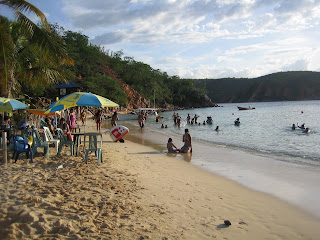 One can observe this effusive air by the anthropogenic sounds too. In addition to the soft breeze, the Latin beats of salsa, merengue, and reggaeton are as loud and inescapable at the beach as they are in the streets of downtown Cumaná. Moreover, my friends (mainly the male ones) constantly joke in a raucous manner without a concern for the volume of their voices. And why should anyone worry? There is no reason to hush one’s voice when children and adults alike scream as they play in the warm Caribbean water.
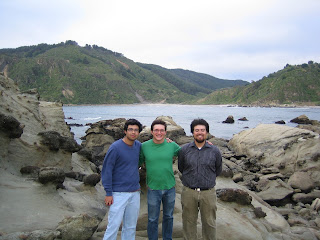
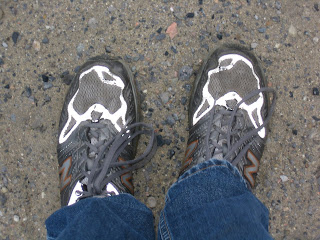 The second beach has a very different feel as I look down at my feet, closed toed shoes still on, and see that the sand is darker and less fine. Though it is on the same continent of South America as Mochima, one sees, feels and hears stark differences in the fishermen’s cove of Llico in southern Chile where I stand with my two good friends Lucho and Cristian Díaz*. Upon looking at the expanse of beach, I see a mosaic composed of seaweed, broken shells, black speckled sand and wind-swept bluffs. Wind is the operative word in this land because it is strong and inescapable, complemented by the crash of the waves. The large trees brave the wind’s force, yet there is certainly no Caribbean palm tree in sight, nor do the locals slurp down piña coladas to wash down their empanadas. Regardless, plenty of Chilean families enjoy the beach’s rugged beauty, though it is not as packed as its aforementioned Venezuelan counterpart. Locals test their nerves in the frigid water of the Pacific Ocean, yet taking a dip is less tempting for me, especially as I think about the tropical waters of Mochima. I am more than content admiring the scenery.
And certain acoustic qualities of the beach in Llico are apparent in every corner of the country. True to its Latin American identity, the streets in the Chile have the ongoing serenade of reggaeton and other Latin American pop music. However, the music is rarely heard at ear-drum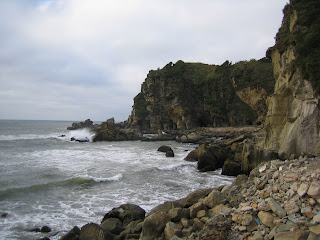 bursting volumes that assault all who trot the streets of Venezuela. I have also noticed that people tend to speak at a slightly hushed volume in Chile, and the jokes told by Chileans come off as more tame and lack the double meaning that is characteristic of the Venezuelan sense of humor. Regardless, I have a wonderful time with Lucho and Cristian, who –like my Venezuelan friends Eliana, Roamir and Pablo – provide great company, local knowledge and their own well-rounded sense of humor. Based on such observations, Chile begins to feel as sincere as much as it is conservative, measured, and subtle in its style.
The juxtaposition of this tamed temperament and the coastal landscape creates a timeless allure in this country. In other words, one encounters warm and inviting people who are willing to share everything in the face of impressive yet less-than-paradisal landscapes. Neither better nor worse than the offerings of Venezuela, it is simply different. Llico absorbs me completely before long, tempting me to stare along the whole coastline as the wind jostles my hair. I cannot get enough of it.
 To answer these questions, I have to take you to two beaches: Mochima in Venezuela, and Llico in Chile. The first might be confused for a steamy version of paradise upon first glance. If you look at your feet, which are probably bare, you see fine white granules of sand, free of garbage, seaweed, and other types of detritus. Looking down further, a soft breeze tosses the crystalline water into gentle waves; a handful of ostentatious yachts rest not far from the hot sand. Mochima is a protected national park near my current residence in Cumaná, Venezuela. On occasions such as this, life feels good, and I cannot kvetch. I am lucky to have the company of my Venezuelan friends Eliana, Roamir, Pablo, and Rachel, another North American English teacher. Of course, we are not alone: other beach-going Venezuelans pack the shore too. Given the hot weather, everyone tends to minimize the amount of clothing worn. For better or worse, the women with bikinis have their speedo-sporting male counterparts as well. "To each his own," I think. The beach in Venezuela typically is no place for modesty.
 One can observe this effusive air by the anthropogenic sounds too. In addition to the soft breeze, the Latin beats of salsa, merengue, and reggaeton are as loud and inescapable at the beach as they are in the streets of downtown Cumaná. Moreover, my friends (mainly the male ones) constantly joke in a raucous manner without a concern for the volume of their voices. And why should anyone worry? There is no reason to hush one’s voice when children and adults alike scream as they play in the warm Caribbean water.
 The second beach has a very different feel as I look down at my feet, closed toed shoes still on, and see that the sand is darker and less fine. Though it is on the same continent of South America as Mochima, one sees, feels and hears stark differences in the fishermen’s cove of Llico in southern Chile where I stand with my two good friends Lucho and Cristian Díaz*. Upon looking at the expanse of beach, I see a mosaic composed of seaweed, broken shells, black speckled sand and wind-swept bluffs. Wind is the operative word in this land because it is strong and inescapable, complemented by the crash of the waves. The large trees brave the wind’s force, yet there is certainly no Caribbean palm tree in sight, nor do the locals slurp down piña coladas to wash down their empanadas. Regardless, plenty of Chilean families enjoy the beach’s rugged beauty, though it is not as packed as its aforementioned Venezuelan counterpart. Locals test their nerves in the frigid water of the Pacific Ocean, yet taking a dip is less tempting for me, especially as I think about the tropical waters of Mochima. I am more than content admiring the scenery.
And certain acoustic qualities of the beach in Llico are apparent in every corner of the country. True to its Latin American identity, the streets in the Chile have the ongoing serenade of reggaeton and other Latin American pop music. However, the music is rarely heard at ear-drum
 bursting volumes that assault all who trot the streets of Venezuela. I have also noticed that people tend to speak at a slightly hushed volume in Chile, and the jokes told by Chileans come off as more tame and lack the double meaning that is characteristic of the Venezuelan sense of humor. Regardless, I have a wonderful time with Lucho and Cristian, who –like my Venezuelan friends Eliana, Roamir and Pablo – provide great company, local knowledge and their own well-rounded sense of humor. Based on such observations, Chile begins to feel as sincere as much as it is conservative, measured, and subtle in its style.
The juxtaposition of this tamed temperament and the coastal landscape creates a timeless allure in this country. In other words, one encounters warm and inviting people who are willing to share everything in the face of impressive yet less-than-paradisal landscapes. Neither better nor worse than the offerings of Venezuela, it is simply different. Llico absorbs me completely before long, tempting me to stare along the whole coastline as the wind jostles my hair. I cannot get enough of it.
*Lucho and Cristian are both from the fishing town Lebu, which is about an hour and a half from Llico. The pictures from Chile in this post were taken in Lebu.
lunes, 8 de diciembre de 2008
Chutzpa and a Venezuelan Bakery
 In Leo Rosten´s lexicographic classic The Joys of Yiddish, the reader can find ample synonyms for the word chutzpa: “gall, brazen nerve, effrontery, incredible ‘guts’,” all of which come from the ancestral Hebrew word for audacity (92-93). I find myself encountering a special type of chutzpa on a frequent basis in Venezuela, and it exists in the form of blunt honesty blended with an affinity to joke about people playfully and constantly. In Spanish, Venezuelans refer to this ubiquitous practice as echar broma, often involving a healthy dose of double entendre. I take you to the local bakery near my apartment in Cumaná to illustrate this.
One day late in the afternoon, I walked into the local bakery. The clerks at the display case were busy as usual while they served the steady flow of customers. “Here comes Harry Potter” I heard one clerk whisper to the other as I approached; nearly everyone in the Bolivarian Republic of Venezuela has told me that I look like Harry Potter. Fighting my way towards the front, as is the standard, I gave my usual “hola, buenas tardes” to the young female clerk who was about to take my order. The clerks had already begun to make fun of me regularly, having been a customer for about a month and a half. This usually had involved exaggerated impersonations of my thick foreign accent. Yet today the practice of echar broma strayed from the limited realm of pronunciation, and the young woman took a different approach.
“Do you like to drink tomato juice,” the clerk asked me.

I responded sheepishly, “No, I do not like tomato juice.” I was a little surprised too.
“You don’t like tomato juice!?”
“No I don’t. Why do you ask?”
“Are you telling me that you never drink tomato juice!?!” she continued.
“He doesn’t like tomato juice,” chimed in a nearby clerk.
I began to feel more nervous, and everyone in line seemed to notice the banter taking place. My body temperature began to rise; someone had turned up the thermostat in eastern Venezuela. “Why do you want to know whether or not I like to drink tomato juice?” I asked vexingly.
“Because you look like a tomato!” she cried out, referring to my rosy complexion aggravated by the tropical climate and embarrassment. The other clerks and a few customers let out a series giggles as I stood at the front of the line speechless.

This chutzpa characterizes the art of echar broma, and I learn everyday that it is something to be embraced and reciprocated.
For this reason, Venezuelans fearlessly make their jokes in a back and forth fashion, pushing the stakes higher and higher. I would call many of their jokes border line harsh by the standards of the United States. In a similar fashion, most nicknames clearly point out a person’s physical imperfections. However, these jokes always end in reassuring and reciprocating grins no matter the degree of audacity employed in the joke.
 So, the next day I figured that the clerks working the counter would have no problem with a photo shoot for my blog. I showed up at the bakery around closing time when customer traffic was minimal and explained to the clerks my reasons for taking a few pictures. They did not understand the concept of a blog during my spiel, yet they quickly revealed excitement after I asked permission to take some pictures. Suffice it to say, the photo shoot was successful.
Sometimes the Venezuelan style of echar broma can come off too boldly, especially since we tend to take jokes on physical appearance quite personally in the United States. Yet as I become more accustomed to these tendencies of Venezuelan culture, I realize that it is a two-way street requiring a proper exchange of quips. Accordingly, I try my best to joke back and with success; my grin seems to be wider and wider each time I leave the bakery.

Work Cited
Rosten, Leo. The Joys of Yiddish. New York: Pocket Books, 1973.
viernes, 5 de diciembre de 2008
La Rumba de Una Boda Venezolana
My good friends Eliana and Roamir invited me to their wedding last weekend, giving me a genuine and incredible taste of a gigantic fiesta venezolana. Venezuelans commonly refer to a party as una rumba, and a wedding is probably one of the best examples. Think Jewish Bar Mitzva party meets Caribbean wedding, and Johnny Walker Whiskey substitutes the Manischewitz wine. After the church ceremony, the highlight of the evening was the infamous "hora loca" (crazy hour). This occurrence resembles carnaval more than anything else as masks, whistles and colorful hats were dispersed to the tunes of merengue, salsa, samba and tambor music. The rumba began to settle down by 3:30 am having begun around 10:00 pm. Take a look for yourself to get an idea of what it was like. You can see my album here. Though not a single champagne glass was broken during the evening, I offer a hearty mazel tov to Eliana and Roamir.
miércoles, 5 de noviembre de 2008
Election Night in Venezuela
Pictures from my Fiesta Electoral
On election night, my friends Albelk and Mery decided to humor me and went along with my idea of an election night party. We watched CCN en Español coverage of the election and tried to make the evening as festive as possible given the short notice and limited resources. Here are some pictures for your enjoyment.

How could the festivities be complete without red, white and blue? The occasion demanded creativity for a few reasons: M&Ms do not exist in Venezuela; the Venezuelan flag colors are red, blue and yellow; and, Venezuela does not represent a particularly large market share for the American flag producing industries.
 The white bread of Venezuela: arepa.
 Mery, Albelk and me before Obama won.
 I waited for Obama to win the neccesary 270 votes in the Electoral College-what suspense!
 Mery, Albelk and me after Obama won. I assure you all that dancing and celebration took place after this point, meaning that I learned a few new dance moves too.
Suscribirse a:
Entradas (Atom)


