
 My work in Cumaná entails an English Teaching Assistantship at the Universidad del Oriente, known by locals as La Udo. Two weeks have passed since my arrival, and I have spent my time getting acquainted with the teachers in the Department of Modern Languages, observing different classes and tutoring students. I have witnessed a sampling of inefficiencies that hamper the smooth function of the university — a hoo-ha here, a hullabaloo there. Yet people at the university maintain a low- or no-stress attitude and a care-free air. This is a counterintuitive curiosity to me.
In this last week alone, I have encountered a plethora of schedule blips and logistic snags that extend beyond the occasional tardy teacher or broken light bulb. For example, three classes that I was to observe – including one scheduled to commence at 7:00 am – never happened. No one showed up. Then there is the issue of electricity, which is something that is especially easy to
 take for granted. On Thursday, the school’s power went out on and off for about three hours. Lights go out, teachers´ technology dependent lessons are foiled, and air conditioning ceases to exist in the midst of 90˚ F heat. A professor told me that President Chavez claims the nation’s rolling blackouts to be the result of conspiracy from the political opposition; many see the blackouts simply as a symptom of overwhelming inefficiency and shoddy maintenance. All the while teachers and students shrug there shoulders and go outside to wait.
People continue to exude an unflappable and tranquil attitude, and that is exactly what most calls my attention.
Generally, most institutions in the United States run smoothly. Business obligations and classes tend to move along in a timely fashion, and public utilities deliver water, electricity and other resources expectedly and efficiently. And who would kvetch about the more temperate weather? Nonetheless, many people are excessively stressed-out in the United States. True, not everyone is on the brink of mental collapse at the exact same time, nor can I express quantitatively the degree to which people stress themselves out in the U.S. However, the relative absence of anxiety and tension here in the Caribbean city of Cumaná is so obvious, qualitatively speaking. Though the U.S. might be a haven for mental health professionals that specialize in stress disorders, Americans can still learn something in this area: a cultural norm to decrease stress.
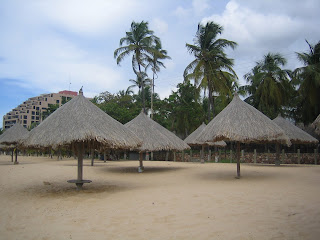 Thus the age-old chicken-and-egg hypothesis comes into play: which came first, the logistical inefficiency or the low stress attitudes? In other words, do the inefficiencies in the country contribute to a decreased urgency, or does a relaxed lifestyle cause inefficiency? At the same time, I do not wish to glorify and romanticize the infrastructure problems that contribute to electricity failures and other public utility shortcomings. The black outs raise other pressing questions too. For example: to what extent do power failures have an impact on the quality of education in Venezuela? Moreover, must efficiency and a lifestyle characterized by low-stress be mutually exclusive?
Readers, please let me know if you think of any other questions worth asking Venezuelans. If you happen to be a Venezuelan reading this, then please do not hesitate to criticize my points. Perhaps only time, some casual investigation and a few more black outs will allow me to craft a more informed speculation.


 My plane hit the tarmac at approximately 5:15 am in Maiquetía Airport, and I had only slept about two or three hours since leaving San Francisco. Fortunately, the frigid yet smooth encounters with Venezuelan immigration and customs officials never fully registered because of my drowsy state. Bumper to bumper traffic and one and a half hours later (“¡At 5:45 in the morning!”), I arrive at the hotel. Not much exploring happened despite the fact that nothing was scheduled. Tropical urban jungle would be the first words that come to mind when describing Caracas. Yet adventures dodging maniacal drivers and standing out seemed like the agenda item for another day; sleep and down time had more appeal.


